
“The success of the BioMed X model depends on the excellence of our scientific leaders.”
Dr. John M. Lindner served as Group Leader of Team IAA at the BioMed X Institute, Heidelberg, from 2018 to 2022, followed by a role as Head of Immunology Discovery from 2023 to 2025, leading interdisciplinary research projects focused on the rapid identification of auto-antigens in autoimmune diseases. Since 2024, he has been serving as Vice President, Head of Research USA & Global Talent Sourcing, helping expand the BioMed X innovation model internationally while supporting the next generation of scientific talent.
As John prepares for his next chapter as Associate Professor at the University of Birmingham in the UK, we spoke with him about scientific leadership, innovation, and his journey at BioMed X.
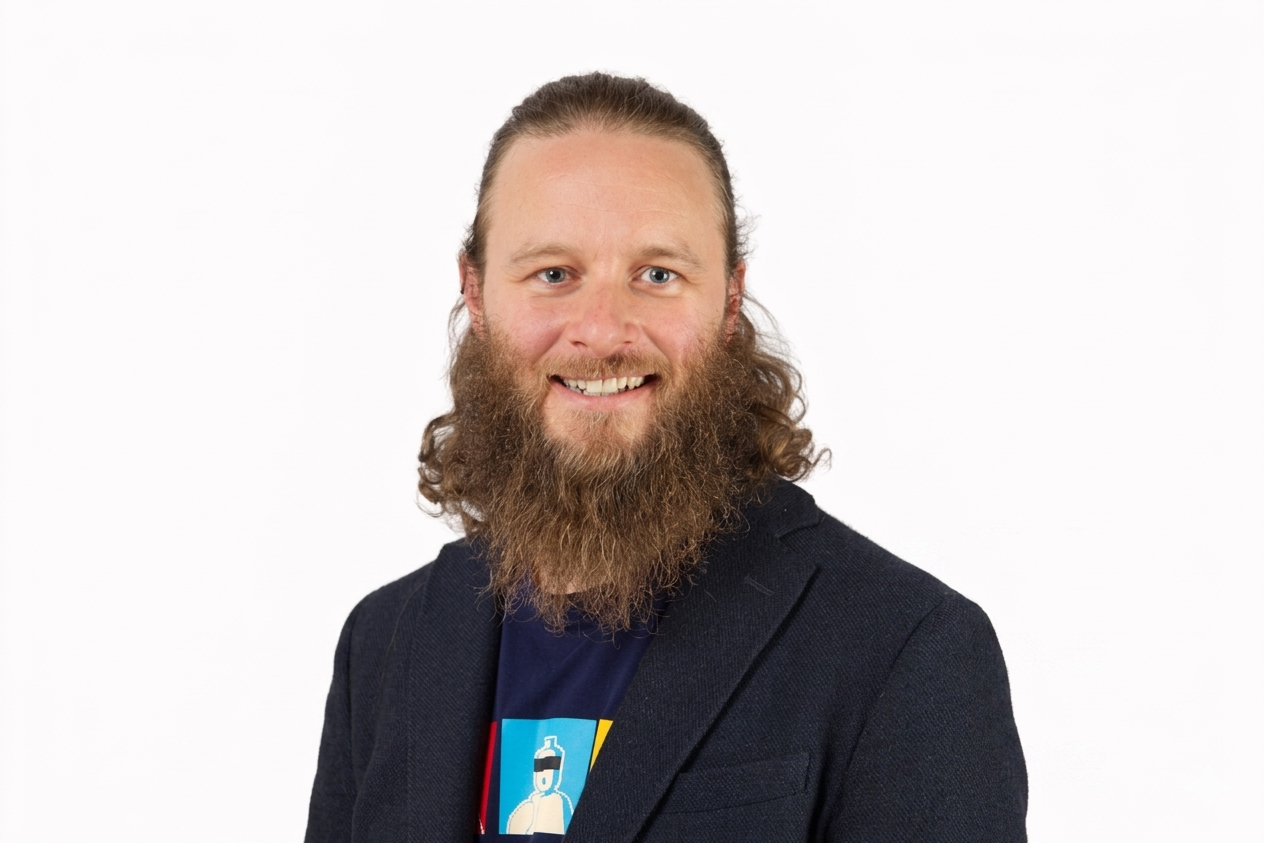
As a former group leader, you experienced the BioMed X model from inside the research environment before moving into leadership. How did that experience influence your perspective on how innovation should happen at the interface between academia and industry?
Dr. John M. Lindner : Frankly speaking, this question is based on the false premise that being a principal investigator of a research team is somehow not “leadership”. In fact, the success of the BioMed X model depends absolutely on the excellence of our scientific leaders. It’s tantamount to alchemy; no amount of skill at the senior management level can “turn lead into gold”. As I joined management, I advocated for creating strong, autonomous group leaders capable of spotting innovative discoveries early, at which point I could provide support based on my own experience translating those findings.
You led team IAA, focusing on the rapid identification of autoantigens in autoimmune diseases. What were the most important lessons you learned while building and leading an interdisciplinary research team?
Dr. John M. Lindner: Learning to balance exploratory work with goal-oriented progress is essential. Too much focus on the former and you will get bogged down in details that don’t matter in the big picture. Too much focus on the latter and you may overlook a key detail that will block you from being successful in the long run. As a great example, one team’s PhD student was struggling with low levels of intracellular protein expression after several days in long-term experiments. Some young scientists would suspect technical issues and spend the rest of their thesis testing various protocols and reagents. Instead, she recognized that something more fundamental might be the issue and pursued this as a separate line of scientific inquiry. Six months later, she had made a breakthrough discovery that solved the problem and hinted at deeper biological phenomena.
In your role as head of Global Talent Sourcing, one of your key responsibilities is identifying and recruiting world-class early-career academic research talent. What qualities do you look for in scientists who have the potential to thrive in the research environment?
Dr. John M. Lindner: You’ve already mentioned the keyword: potential. We strongly consider not the researcher who gets hired on Day 1, but the scientist we will give back to the community at the end of a project. Many applicants possess strong expertise in relevant techniques, and of course, this is an important factor, but not without evidence of ambition and a willingness to grow beyond their current tool set. I personally value scientific breadth and diversity, and look for signs that an applicant is enthusiastic about learning new things, solving “unsolvable” problems, and generating elegant approaches to challenges.
Over the past two years, you have also served as head coach for multiple BioMed X boot camps. What makes the boot camp format such a powerful tool for evaluating scientific talent and fostering innovation?
Dr. John M. Lindner: The Boot Camp experience lets us observe early-career researchers in action, under pressure, and isolated from any dependence on a supervising “idea generator”. Spotting problems and proposing solutions on a highly compressed schedule is key to success at BioMed X (and, I would argue, in many other organizations.) It’s the late-night, eleventh-hour sparks that show us the potential of young scientists who have them, and these flashes of brilliance don’t show up in CVs, cover letters, or interviews.
Having worked in Germany, Switzerland, and now the United States, how have international research environments influenced your leadership style and your understanding of global scientific collaboration?
Dr. John M. Lindner: It’s more important to focus on the similarities than any perceived differences in international approaches to science. People from diverse personal circumstances, cultures, and lived experiences are united in the pursuit of excellent science, putting evidence-based decision-making above whatever differences they may believe separate them.
What has been the most exciting and rewarding part of building and leading BioMed X in the USA?
Dr. John M. Lindner: Perhaps ironically to those building our capacities hands-on, my favorite moments were watching new groups create infrastructure where none was available, finding strategic solutions that worked within the resource frameworks available to them.
As an example, our first two groups both required advanced microscopy for their experiments. One group leader convincingly appealed to their pharmaceutical sponsor for the purchase of a new instrument, which would add value to the entire ecosystem. The other resuscitated a 20-year-old instrument purchased at a fraction of its original price on a laboratory equipment auction site. Seeing labs emerge from empty spaces is a very special thing for any early-career researcher, and while I can’t claim direct ownership over those processes, it was rewarding to observe and experience the thrill vicariously.
BioMed X is known for combining the best of both worlds: academia and industry. From your perspective, why is this model becoming increasingly important for the future of drug discovery and development?
Dr. John M. Lindner: I’m likely to get in some trouble for this one, but: why do we keep thinking of “academia” and “industry” as two separate worlds? To the sci-fi nerd in me, they are more like parallel realities overlaid upon and interacting with each other. Success in either requires the same attributes: predicting future trends, uttermost reliance on data and facts, and being able to thrive in competition for limited resources. Likewise, the same challenges can also plague both: hierarchies that sometimes restrict more than they enable, only being able to progress as the slowest aspect of the project, ignoring or being oblivious to key stakeholders. Perhaps BioMed X is the vanguard in connecting the two more tangibly, but I often wonder why our approach still feels so unique when this seems so obvious.
Before BioMed X, you trained and worked at institutions such as the Max Planck Institute and Novartis Biomedical Research. What were the most valuable lessons you took from academia versus industry?
Dr. John M. Lindner: The people you interact with are more important than the institution or label put on it. From my PhD mentor, I learned to be detail-oriented, because details are what make or break your experimental design. From my postdoc mentor, I learned to think big and stay relevant. From colleagues everywhere, I learned that being successful means asking the right question at the right time and putting in the work to get your answer.
Was there a particular moment at BioMed X where you realized the impact you were having, either scientifically or personally, on younger researchers?
Dr. John M. Lindner: I don’t know if I’ve ever felt I can personally take credit for someone else’s achievements. I would like to think that I provide many creative impulses, some of which may end up being insightful and pursued in subsequent experiments.
Since research is ultimately a team effort and I haven’t independently conducted an experiment from start to finish in some time, my individual contributions to the successes of younger researchers are likely not quantifiable. It is important to create a space in which those researchers can thrive, and I do think I’ve managed that, measured by the ability of BioMed X alumni to find future positions aligned with their goals, whether they be highly reputable graduate schools, leadership positions in pharma, or research-adjacent roles requiring strong critical thinking skills.
What advice would you give to young scientists who aspire not only to conduct excellent research but also to become effective leaders and innovators?
Dr. John M. Lindner: No one is interested in your solution if they don’t believe in the problem. We often tell Boot Camp participants to start from a point at which their project has been completed and imagine the impact their work will have. Then work backward, listing any reasons why such a future isn’t already here – these are the problems that need to be solved along the way! Going back and forth enables the generation of strong hypotheses and a well-controlled experimental design, and global relevance is already built in. And for love of all that is (scientifically) holy, stop using LLMs to replace your imagination!
Congratulations on your new role as Associate Professor of Lymphocyte Receptor Recognition in the Department of Immunology and Immunotherapy at the University of Birmingham!
Dr. John M. Lindner: Thank you very much! I’m looking forward to taking everything I’ve learned here, both scientifically and personally, on to the next step in my career. While it will certainly be a bittersweet departure from BioMed X, I’ve found a familiar future home in the University of Birmingham, which endorses a similar set of core values embracing diversity, translating discoveries, and aiming high. My lab will focus on the role of lymphocytes in recognizing both self- and foreign antigens, which drives long-lived adaptive immune responses for both good and bad. I will be joining a strong team of research and clinical scientists, and anticipate making many new as well as strengthening existing connections!